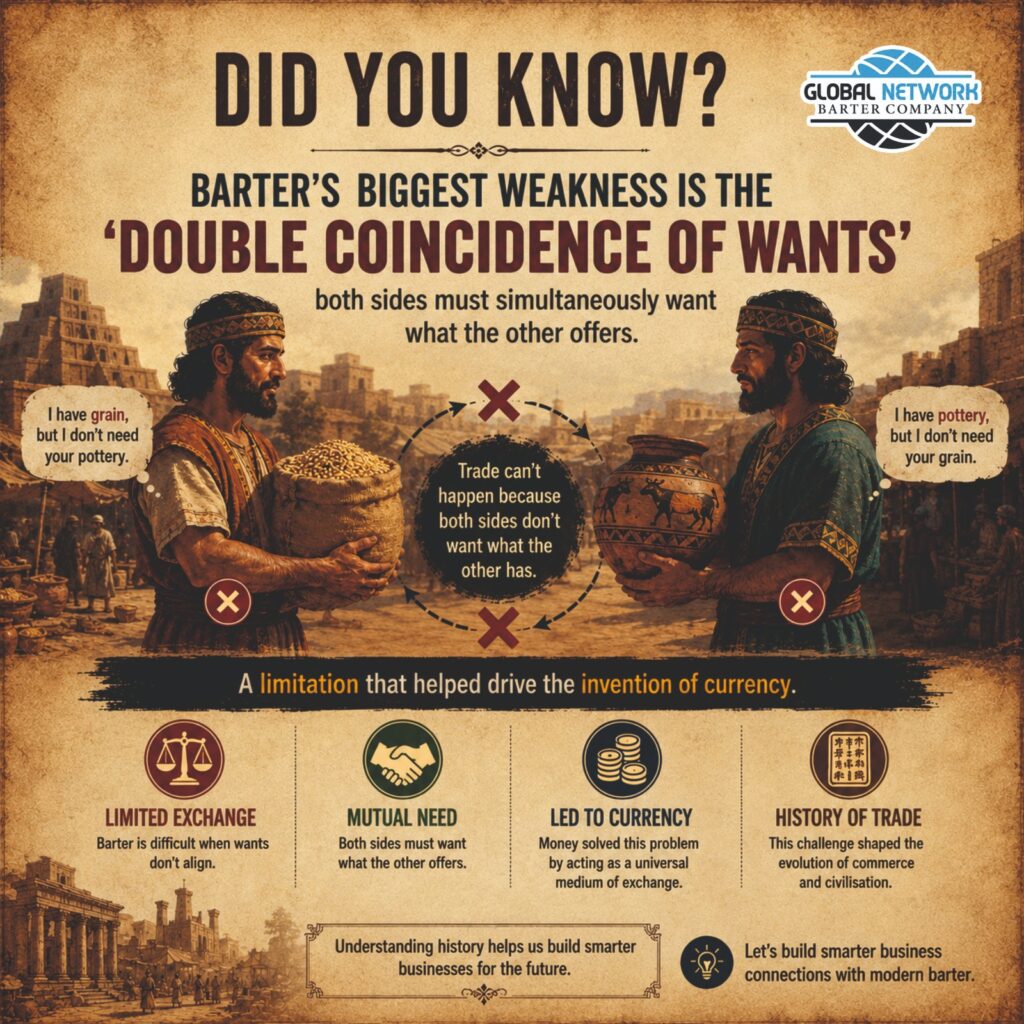
For thousands of years, the Barter System was one of the earliest methods of trade. People exchanged goods and services directly without using money. While this worked in small communities, the system had one major flaw—the “double coincidence of wants.”
What Is the Double Coincidence of Wants?
The double coincidence of wants means that for a successful barter transaction, both parties must want exactly what the other is offering at the same time.
For example, imagine a furniture manufacturer wants advertising services, while an advertising agency only needs office computers. If neither party needs what the other offers, the trade cannot happen. This limitation made traditional barter slow, inefficient, and difficult to scale. As trade expanded across regions, the need for a universal medium of exchange eventually led to the invention of currency.
How Modern Barter Solves This Problem
Today’s Business Barter system has evolved significantly. A professional B2B Barter Agency in India connects thousands of businesses through a structured Barter Exchange Network in India, allowing companies to trade products and services without requiring a direct one-to-one exchange.
A trusted Barter Exchange Company in India records the value of transactions using trade credits, enabling businesses to buy from one member and sell to another independently. This removes the biggest weakness of traditional barter while preserving its greatest advantage—reducing cash expenditure.
Benefits of Working with a B2B Barter Company
Partnering with a reliable B2B Barter Company in India offers several business advantages:
- Improve cash flow by reducing cash-based purchases.
- Convert surplus inventory into valuable business assets.
- Utilize unused production capacity and service hours.
- Expand your customer network through a trusted Barter Exchange.
- Increase brand visibility with Media Barter Advertising.
- Access strategic Barter Marketing Services in India.
- Build long-term partnerships through a secure Business Barter Platform in India.
Why Businesses Choose Professional Barter Services
Leading organizations work with experienced Barter Consultants and Barter Firms because organized barter creates measurable business value. Whether you are looking for Corporate Barter, a Barter Advertising Company, a Barter Media Agency, or a Barter Trading Company, an established barter partner can help optimize your resources while supporting business growth.
Professional Barter Agencies in India also provide transparent valuation, structured trade processes, reliable member networks, and dedicated account management. This makes modern barter far more efficient than the traditional system practiced centuries ago.
Choosing the Right Barter Partner
When selecting a Barter Company in India, consider a provider that offers:
- Comprehensive B2B Barter Services in India
- A strong Barter Exchange Network in India
- Professional Barter Marketing Services
- Expertise in Corporate Barter and Media Barter Advertising
- A secure Barter Trade Exchange Company in India
- Reliable Online Bartering solutions
- Transparent transactions and dedicated support
The Best Barter Companies in India focus on creating long-term value by helping businesses exchange products, services, advertising opportunities, and media while minimizing cash outflow The “double coincidence of wants” was the biggest obstacle that limited traditional barter and encouraged the development of currency. However, modern technology and organized barter exchanges have transformed the concept into an efficien